Description
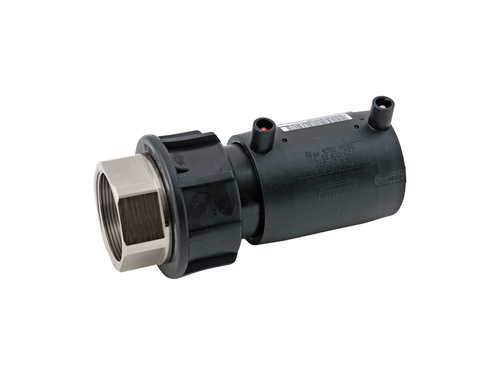
The Reducing Coupling is a high-performance industrial electrofusion fitting designed for seamless integration with HDPE poly pipe systems, ensuring reliable and efficient connections in various applications. This fitting utilises advanced resistive electrofusion welding technology, where embedded heating wires are energised by an electrofusion control unit to create a strong bond with the polyethylene pipe surface. Compatible with electrofusion control units, butt-weld pipework, and stub flange kits, the Reducing Coupling guarantees leak-free permanent joints that are essential for maintaining system integrity. Its traceable jointing process enhances accountability and quality assurance, making it ideal for both trench and confined-space installations. With proven reliability in pressurised systems, this fitting not only simplifies the installation process but also ensures long-lasting performance, making it a vital component for any industrial piping project.
Features
- Embedded heating wire construction for consistent and reliable fusion.
- Barcode-controlled welding parameters to ensure precise joint integrity.
- Polyethylene body designed to match pipe SDR for optimal compatibility.
- Available in a broad size range to accommodate various industrial applications.
- Variants include couplers, reducers, tees, and tapping tees for versatile installation options.
- Suitable for both water and gas service, meeting industry standards.
- Traceable jointing data for enhanced accountability and quality assurance.
- Pressure ratings compliant with AS/NZS standards for reliable performance.
Applications
- Ideal for connecting different pipe diameters in natural gas mains, ensuring efficient gas distribution.
- Facilitates seamless transitions in water reticulation pipelines, enhancing flow management and system integrity.
- Robust solution for mining process water applications, providing reliable connections in harsh environments.
- Essential for civil infrastructure projects, enabling durable and leak-proof joints in various pipeline systems.
- Optimised for dewatering networks, ensuring effective drainage and water management in construction sites.
- Designed for industrial pipelines, offering high strength and resistance to pressure fluctuations.
- Supports trenchless installations, minimising surface disruption while maintaining pipeline integrity.
- Suitable for confined-space jointing, allowing safe and efficient assembly in restricted access areas.